
Coil binding machines, built to last.
Punch, insert and crimp professional coil-bound documents in minutes. Four models, from entry-level to high-volume, for offices, schools and print shops across North America.
- Ships from Toronto
- 2-year warranty on S-25A
- 50+ years in business

Four CoilBind machines.
Every model takes 4:1 pitch coils. Choose by your volume and team size.


| CoilBind S-12 Entry | CoilBind S-15 Popular | CoilBind S-20 Best value | CoilBind S-25A Flagship | |
|---|---|---|---|---|
| Punch capacity | 12 sheets | 12 sheets (80g) | 20 sheets (20#) | 20 sheets (20#) |
| Coil inserter | Manual | Electric | Electric | Electric |
| Crimper | Sold separately | Included | Sold separately | Included |
| Extras | Portable, binds up to 2″ | — | Full handlebar for left, right or two-handed punching | Adjustable margins, disengaging pins, open throat, 100 free 8mm coils |
| Warranty | Manufacturer | Manufacturer | Manufacturer | 2-year manufacturer |
Bind a document in 3 steps.
Every CoilBind machine goes from loose pages to a finished presentation in under 60 seconds.
What customers are saying.
“It feels really sturdy and the operation couldn't be smoother. All around wonderful machine, would recommend.”
“This machine is a money-saver and time-saver. In just 2 jobs I saved $180 in binding costs. My reports look better than from printing companies.”
“The newer model is so smooth when hole punching. I can't believe how much I missed in upgrading. Five years of daily use and it's still going strong.”
Coil binding vs comb binding.
Both punch holes along the spine and both let a document lie flat, but they behave very differently in daily use.
| Coil binding | Comb binding | |
|---|---|---|
| Spine | One continuous plastic spiral threaded through every hole | A row of plastic teeth that hook into rectangular slots |
| Page rotation | Full 360°, pages fold all the way back | Roughly 180°, the comb blocks a full fold-back |
| Hole pattern | Round holes, 4:1 pitch (four per inch) | Rectangular slots, 19 holes on a letter page |
| Editing pages | Coil must be removed and replaced to add sheets | Comb reopens on the machine, so pages swap in seconds |
| Durability | Coil springs back into shape after handling | Teeth can splay or pop open under heavy use |
| Max thickness | About 2 inches with a 50mm coil | About 2 inches; larger combs cost less per unit |
| Finishing | Both coil ends are crimped | No crimping, the comb simply closes |
| Best for | Reports, cookbooks, manuals, notebooks | Drafts and internal handouts that get revised |
How coil binding works.
What is coil binding?
Coil binding, also called spiral binding, fastens a stack of pages with a single continuous plastic coil threaded through a row of round holes punched along the spine edge. The coil is then crimped at both ends so it cannot unwind.
Because the spine is one flexible spiral rather than a rigid clamp, a coil-bound document opens completely flat and the front cover folds all the way around to the back. That makes it the standard choice for cookbooks, service manuals, training workbooks and any document read while your hands are busy.
How do you use a coil binding machine?
- Punch. Square up the stack, drop it into the punch throat against the paper guide and pull the handle. Punch in batches up to the machine's capacity: 12 sheets on the S-12 and S-15, 20 on the S-20 and S-25A.
- Pick the coil size. Measure the punched stack and choose a coil roughly 2mm larger than its thickness, so pages turn freely.
- Insert. Rest the coil against the electric inserter roller and feed it in. The roller spins it through all the holes; on manual models you roll it through by hand.
- Crimp. Trim the coil about a quarter inch past the last hole at each end, then bend both tips inward with a crimping tool.
What is 4:1 pitch, and does it matter?
Pitch is how many holes are punched per inch along the spine. 4:1 pitch means four holes per inch and is the most common spacing for plastic coil in North America. Every CoilBind machine punches 4:1, so any 4:1 coil fits any of them, and coils bought for one machine work on the next.
The alternative, 5:1 pitch, uses five smaller holes per inch and is far less widely stocked. Sticking with 4:1 keeps supplies interchangeable and easy to reorder.
Manual or electric coil inserter?
The punch is manual on all four machines. The difference is how the coil goes in. A manual insert means twisting the coil through by hand, which is fine for a few documents a week. An electric inserter spins it through in a couple of seconds.
If you bind more than about ten documents a week, or anything thicker than half an inch, the electric inserter on the S-15, S-20 and S-25A pays for itself quickly in saved time and fewer bent coils.
Plastic binding coils.
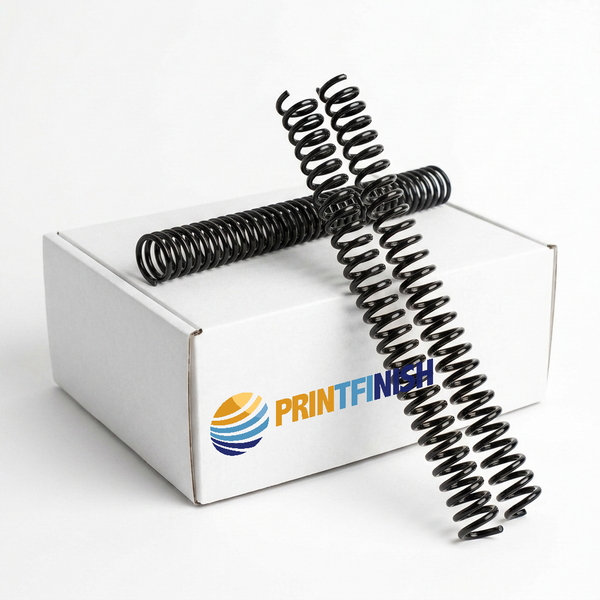
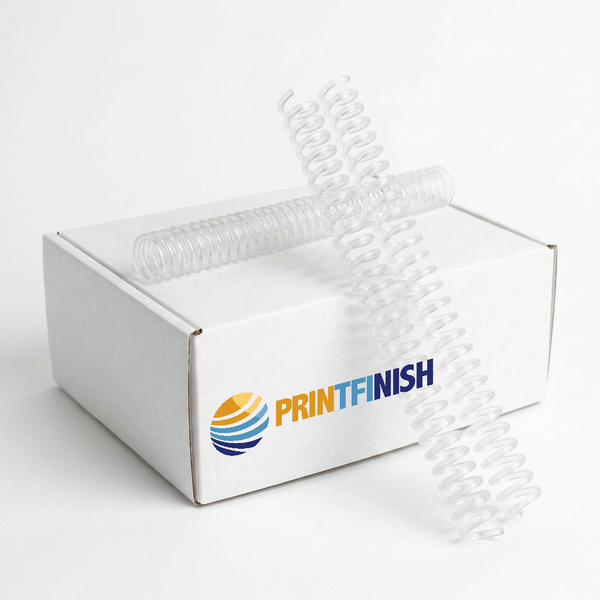
4:1 pitch coils that fit every CoilBind machine. Five colours, 6mm to 32mm, boxes of 100.



Coil binding questions, answered.
What's the difference between the CoilBind S-15 and S-20?
The S-15 has a 12-sheet punch capacity and a fixed handle, ideal for occasional binding in small offices. The S-20 steps up to a 20-sheet punch capacity and a full handlebar that supports left-, right- or two-handed punching, making it the better choice for busier offices.
What coil sizes fit CoilBind machines?
All CoilBind machines use 4:1 pitch plastic binding coils, from 6mm up to 32mm. Smaller coils (6 to 10mm) suit thin documents, while larger coils (25 to 32mm) bind books up to about 2 inches thick. Coils come in black, white, clear, navy and royal blue in boxes of 100.
Does the CoilBind S-25A include coils?
Yes. The S-25A ships with 100 free 8mm plastic coils and a coil crimper, so you can start binding the moment it arrives. It also carries a 2-year manufacturer warranty.
What is coil binding?
Coil binding, also called spiral binding, fastens pages with a single continuous plastic coil threaded through round holes punched along the spine edge, then crimped at both ends. A coil-bound document opens completely flat and the cover folds all the way back.
What is the difference between coil binding and comb binding?
Coil uses one continuous plastic spiral through round 4:1 pitch holes and rotates a full 360 degrees. Comb uses a row of plastic teeth in rectangular slots and rotates about 180 degrees. Coil is more durable and looks more finished; comb lets you add or remove pages after binding.
How do you use a coil binding machine?
Punch the pages in batches up to the machine's sheet capacity, choose a coil about 2mm larger than the punched stack, feed the coil onto the electric inserter roller so it threads through every hole, then trim and crimp both ends.
What does 4:1 pitch mean?
4:1 pitch means four holes per inch along the spine, the most common spacing for plastic coil in North America. All CoilBind machines punch 4:1, so any 4:1 coil fits any of them.
Do I need a separate crimper?
A crimper flattens both ends of the coil so the binding locks in place. The S-15 and S-25A include a crimper in the box. For the S-12 and S-20 a coil crimper can be added separately.
Ready to bind smarter?
Fast dispatch from Toronto and Florida.